MSc Project Management UK | Accredited Master's Degree
Course Overview
The MSc Project Management is a postgraduate degree designed for graduates and professionals who want to develop advanced knowledge and practical expertise in planning, managing and delivering projects successfully across different industries.
Project management plays an essential role in modern organisations. Businesses, governments and international institutions rely on effective project management to introduce new products, develop infrastructure, implement technology, manage organisational change and achieve strategic objectives.
From major construction and engineering developments to digital transformation, healthcare innovation and international business initiatives, organisations need skilled project professionals who can manage resources, control budgets, coordinate teams and deliver results within agreed timescales.
The MSc Project Management at the University of Westminster provides an opportunity to develop the strategic, leadership and technical capabilities required to manage projects in increasingly complex and changing business environments.
The programme explores important areas of project management, including project planning and control, agile project management, project leadership, project finance, procurement, value and benefits realisation and international project delivery.
Students also examine how emerging technologies, artificial intelligence, responsible management practices and organisational change are influencing the future of project management.
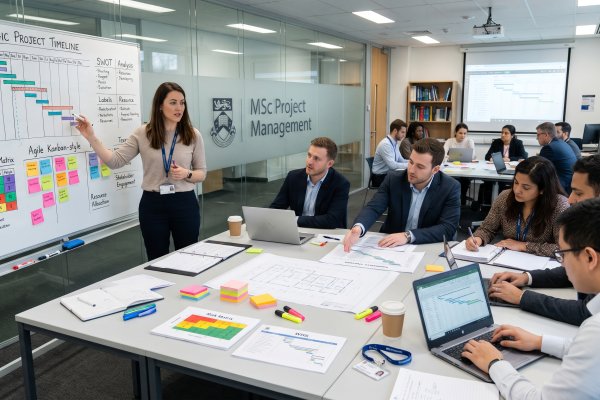
The programme combines academic learning with practical activities, real-world case studies, project simulations, group assignments and independent research. Students develop the ability to evaluate project requirements, manage risks, coordinate stakeholders, allocate resources and make informed decisions throughout the project lifecycle.
A particular focus is placed on developing professional leadership, communication, teamwork, strategic thinking and problem-solving skills.
The programme also provides opportunities to gain additional professional qualifications, including PRINCE2 Foundation or AgilePM Foundation certification at no extra cost, subject to the university's applicable arrangements.
The MSc Project Management is particularly suitable for graduates in Business Management, Economics, Engineering, Information Technology, Operations Management and other relevant disciplines who want to build careers in project management, programme management, consulting and organisational transformation.
What Will You Study?
The MSc Project Management at the University of Westminster is a one-year, full-time postgraduate programme designed to develop advanced project delivery, leadership and strategic management capabilities.
The programme combines technical, behavioural and strategic perspectives of project management. Students learn how to plan, schedule, monitor and control projects while developing the leadership and communication skills needed to work effectively with different stakeholders and project teams.
Core Modules
The published programme structure includes the following compulsory modules:
Project Planning and Control: Explore the fundamental principles, methodologies and techniques used to plan and manage projects. Understand project scope, scheduling, resource allocation, monitoring, performance measurement and control mechanisms. Develop the ability to assess project progress and implement appropriate corrective actions to support successful delivery.
Project Leadership: Examine the behavioural and organisational aspects of project management. Explore leadership approaches, group dynamics, stakeholder relationships, organisational change, project politics, quality management and responsible project leadership. Develop the interpersonal skills required to motivate teams and manage complex working relationships.
Agile Project Management: Develop practical knowledge of agile project management methodologies, tools and techniques. Explore approaches such as Scrum and Kanban, understand iterative project delivery and examine how agile principles can be applied in IT, digital services and other knowledge-based industries.
Value and Benefits Realisation: Understand how organisations define, measure, deliver and sustain value through projects and programmes. Explore the relationship between strategic objectives, project outcomes and long-term organisational benefits. Develop the ability to evaluate whether projects achieve their intended business and strategic value.
Project Finance and Procurement: Examine the financial and commercial responsibilities of project managers. Explore project funding, budgeting, financial planning, procurement strategies, supplier relationships and purchasing decisions. Understand how effective financial and procurement management contribute to project success.
Capstone Project: Complete a substantial independent project that allows you to apply your academic knowledge and project management capabilities to a relevant practical or research-based challenge. Choose between a traditional dissertation and a project report based on, or commissioned by, an actual organisation. Develop research, critical thinking, problem-solving and professional reporting skills.
Optional Modules
Students can tailor their learning through specialist optional modules, subject to availability and academic arrangements.
The published programme includes options such as:
Managing International Projects: Explore the additional challenges involved in managing projects across different countries, cultures, political environments and organisational settings. Understand international stakeholder management, cross-cultural communication and the complexities of global project delivery.
Product Management: Examine the relationship between project management and product development. Explore product lifecycles, value creation, agile approaches, DevOps and the challenges of managing products in rapidly changing business environments.
AI and Emerging Technologies in Projects: Investigate how artificial intelligence and emerging technologies are transforming project management. Explore opportunities to improve project decision-making, delivery processes and organisational performance through technological innovation.
Optional module availability may depend on student demand, timetabling and academic staffing.
Additional Project Management Knowledge
Through the programme's modules and applied learning activities, students can also develop broader knowledge of contemporary project management practices.
Important subject areas include:
Project Risk Management: Identify, assess and manage risks that may affect project objectives, budgets, schedules and quality. Understand risk mitigation, contingency planning and risk monitoring.
Project Scheduling: Develop knowledge of project timelines, work breakdown structures, dependencies, critical path analysis and resource scheduling.
Stakeholder Management: Understand how to identify stakeholders, evaluate their interests and expectations, manage communication and build effective working relationships.
Project Governance: Explore organisational structures, accountability, decision-making processes and governance arrangements that support successful project delivery.
Programme and Portfolio Management: Understand how organisations coordinate multiple projects and programmes to achieve broader strategic objectives.
Change Management: Examine how organisations manage change, overcome resistance and support the successful implementation of new systems, processes and organisational initiatives.
Project Performance Measurement: Explore key performance indicators, project reporting, monitoring techniques and methods for evaluating delivery outcomes.
Responsible Project Management: Understand the ethical, environmental and social responsibilities associated with modern project delivery, including sustainability and the United Nations Sustainable Development Goals.
These additional subject areas complement the published programme and help students understand the wider responsibilities of professional project managers.
The exact module titles, credit values and optional module availability should be checked against the university's latest approved programme specification.
Who Is This Course For?
The MSc Project Management is designed for graduates and professionals who want to develop advanced project management, leadership and strategic decision-making capabilities.
It may be particularly suitable for:
Graduates in Business Management.
Graduates in Business Administration.
Graduates in Economics.
Graduates in Engineering.
Graduates in Information Technology.
Graduates in Computer Science.
Graduates in Operations Management.
Graduates in Construction Management.
Graduates in Supply Chain Management.
Graduates in Events Management.
Professionals interested in project coordination.
Business professionals seeking project leadership roles.
IT professionals interested in managing digital transformation projects.
Engineering professionals seeking project management careers.
Individuals planning careers in programme management and consultancy.
The programme also welcomes applicants from a range of academic backgrounds, including environmental sciences, humanities and languages, subject to the university's admission requirements.
Professionals with relevant alternative qualifications and at least three years of relevant professional experience may also be considered.
Entry Requirements
The MSc Project Management at the University of Westminster is designed for applicants who have successfully completed an appropriate undergraduate qualification or meet the university's alternative professional entry criteria.
The published standard entry requirements include:
A minimum lower second-class honours degree (2:2) or equivalent.
A recognised bachelor's degree from an approved institution.
Relevant academic or professional preparation for postgraduate study.
Relevant academic backgrounds may include:
Business Studies
Economics
Events Management
Operations Research
Engineering
Information Technology
Environmental Sciences
Humanities
Languages
Other related disciplines
Applicants with degrees in different subject areas are encouraged to apply, as the programme accepts a broad range of academic backgrounds.
Alternative Professional Entry
Applicants who do not hold a conventional relevant bachelor's degree may also be considered through alternative professional qualifications.
The university may consider applicants who have:
An appropriate alternative professional qualification.
At least three years of relevant professional experience.
Evidence of suitable academic and professional capabilities.
A current CV is expected for applicants using this alternative entry route.
An interview may be required for non-standard applications, either in person or online.
International Academic Qualifications
International applicants must demonstrate that their previous qualifications meet the university's postgraduate admission requirements.
Relevant qualifications may include:
Bachelor's degrees in Business Administration.
Bachelor's degrees in Business Management.
Bachelor's degrees in Engineering.
Bachelor's degrees in Computer Science.
Bachelor's degrees in Information Technology.
Bachelor's degrees in Economics.
Bachelor's degrees in Operations Management.
Other recognised overseas qualifications equivalent to a UK honours degree.
Applicants should provide:
Previous academic certificates.
Complete academic transcripts.
Details of previously studied subjects and modules.
Updated CV, where required.
Evidence of relevant professional experience, where applicable.
Evidence of English language proficiency.
Any additional documents requested by the university.
International qualifications are assessed according to the University of Westminster's country-specific admission requirements.
English Language Requirements
International applicants must demonstrate sufficient English language proficiency to participate in postgraduate academic study.
For the University of Westminster's published requirements:
IELTS Academic: 6.5 overall.
Minimum 6.0 in each component.
Approved equivalent English language qualifications may also be accepted under the university's admissions policy.
Applicants should confirm the latest requirements before submitting an application.
Practical Learning and Project Management Experience
Practical learning is an important component of professional project management education.
The programme at the University of Westminster combines academic study with applied project activities, simulations, real-world case studies and collaborative learning.
Students develop the ability to apply project management principles to practical organisational challenges.
Practical learning may include:
Developing project management plans.
Preparing project schedules and timelines.
Creating work breakdown structures.
Analysing project risks and developing mitigation strategies.
Managing project budgets and financial resources.
Evaluating procurement strategies.
Conducting stakeholder analysis.
Developing agile project delivery approaches.
Managing project teams and organisational change.
Evaluating project performance.
Preparing professional project reports.
Conducting independent project research.
Working on practical industry-related projects.
The university also incorporates project simulations and virtual reality into learning activities to help students understand different aspects of project delivery.
Students may undertake real-world project assignments and work with practical scenarios that reflect the challenges faced by project managers in contemporary organisations.
These experiences help students develop confidence in project planning, leadership, communication and strategic decision-making.
Skills You Will Develop
Throughout the programme, students can develop a range of advanced technical, managerial and professional skills, including:
Project planning and control
Strategic project management
Agile project management
Project leadership
Risk management
Project finance and budgeting
Procurement management
Stakeholder management
Programme management
Value and benefits realisation
Organisational change management
Project governance
Project performance evaluation
Team leadership and collaboration
Professional communication
Strategic decision-making
Critical thinking and problem-solving
Research and analytical skills
Responsible project management
Project reporting and documentation
These transferable skills can support career development across construction, engineering, IT, finance, healthcare, manufacturing, consultancy and international business.
Career Opportunities
The MSc Project Management can provide an academic and professional foundation for exploring employment opportunities across project delivery, programme management, consulting and organisational transformation.
Potential career pathways include:
Project Manager
Assistant Project Manager
Project Coordinator
Project Administrator
Programme Manager
Project Management Consultant
Project Planner
Project Scheduler
Project Control Analyst
Risk Manager
Product Manager
Associate Product Manager
Project Director
Change Management Consultant
Business Transformation Manager
Project Management Office (PMO) Analyst
Operations Project Manager
Quality Manager
Procurement Project Manager
Project Support Officer
Graduates may find opportunities with:
Construction and engineering companies.
Financial institutions.
IT and software development organisations.
Healthcare organisations.
Government departments.
International development organisations.
Consulting firms.
Manufacturing companies.
Telecommunications businesses.
Infrastructure and transport organisations.
Multinational corporations.
Public and private sector organisations.
The professional capabilities developed through the programme can support progression from project coordination and support roles into more senior project, programme and organisational leadership positions.
Career progression depends on individual experience, employer requirements and continued professional development.
Professional Recognition and Accreditation
Professional recognition is an important consideration when choosing a postgraduate project management programme.
The MSc Project Management at the University of Westminster has professional accreditation from two major project management organisations.
Association for Project Management (APM)
The programme is accredited by the Association for Project Management (APM), the chartered professional body for the project management profession in the UK.
Eligible students receive free annual APM student membership, providing access to professional resources, publications, knowledge materials and networking opportunities.
Project Management Institute (PMI)
The programme is also accredited by the Project Management Institute (PMI) Global Accreditation Center for Project Management Education Programs (GAC).
Graduates of PMI/GAC-accredited programmes can receive a 12-month reduction in the professional experience requirement when applying for specified PMI certifications, including:
Project Management Professional (PMP).
Program Management Professional (PgMP).
Portfolio Management Professional (PfMP).
PMI Risk Management Professional (PMI-RMP).
PMI Scheduling Professional (PMI-SP).
Applicants should check the current PMI certification eligibility rules before applying.
Additional Professional Certifications
Students also have opportunities to gain additional professional qualifications through the university's training arrangements.
These include:
PRINCE2 Foundation.
AgilePM Foundation.
Professional Scrum Master I (PSM I) assessment opportunity.
Certification assessments and eligibility conditions are subject to the university's applicable arrangements.
Professional accreditation and additional certifications can help graduates strengthen their professional profiles and demonstrate knowledge of recognised project management methodologies.
Progression to Further Study
After successfully completing the MSc Project Management, graduates may consider further academic research or specialist postgraduate development.
Potential progression routes include:
PhD in Project Management.
PhD in Management.
PhD in Business Administration.
PhD in Operations Management.
PhD in Construction Project Management.
PhD in Engineering Management.
PhD in Organisational Studies.
Doctoral research in Project Governance.
Doctoral research in Risk Management.
Doctoral research in Sustainable Project Management.
The master's degree can provide an academic foundation for doctoral applications, subject to the research institution's admission requirements and the applicant's research background.
Graduates interested in academic or research careers may also explore research assistant, research associate and doctoral researcher opportunities.
Course Duration and Study Mode
The MSc Project Management at the University of Westminster offers the following study arrangement:
Study duration: One year.
Study mode: Full-time.
Start date: September 2027.
Campus: Marylebone Campus, Central London.
Qualification: Master of Science.
Study level: Postgraduate.
The programme combines lectures, seminars, workshops, practical activities, project simulations, group assignments and independent study.
Students develop their academic and professional capabilities through a combination of taught modules, practical project work and independent research.
Assessment methods may include reports, essays, presentations, practical coursework, assignments and a substantial capstone project.
The capstone project provides an opportunity to complete either a traditional dissertation or a practical project report based on an actual organisation.
Tuition Fees and Intakes
Tuition fees depend on the academic year and applicant category.
For the University of Westminster's published 2027/28 academic year:
International tuition fee: £18,685.
UK tuition fee: £12,355.
Full-time duration: One year.
September 2027 intake.
Campus: Marylebone, Central London.
The university's published course information also displays a January entry option. Applicants interested in January should confirm the relevant academic year, course availability and application deadlines directly with the university.
Tuition fees may be subject to change for future academic years. Applicants should also confirm scholarships, payment arrangements, deposits and any additional costs before accepting an offer.
Why Study Project Management in the UK?
The UK is an established destination for postgraduate business education, professional development and project management training.
UK universities offer programmes that combine strategic management, leadership, technical knowledge and practical project delivery skills to prepare graduates for professional responsibilities across different industries.
Studying an MSc Project Management in the UK provides an opportunity to develop advanced knowledge of project planning, risk management, agile methodologies, project finance, stakeholder engagement and organisational transformation.
The UK also has a diverse economy involving construction, engineering, finance, healthcare, technology, manufacturing and international business, creating a wide range of environments in which project management skills are valuable.
Professional accreditation from recognised organisations such as APM and PMI can further strengthen the academic and professional value of a postgraduate qualification.
Whether your ambition is to become a project manager, programme manager, project management consultant, product manager or organisational transformation professional, this master's degree can provide a valuable next step in your academic and professional journey.
Get Guidance on Studying MSc Project Management in the UK
Choosing the right MSc Project Management programme involves comparing university options, academic entry requirements, professional accreditation, specialist modules, practical learning opportunities, tuition fees and career progression routes.
Our education consultancy can help prospective students assess their academic qualifications, explore suitable UK university options and prepare their postgraduate applications.
Contact our team for guidance on the MSc Project Management and opportunities to advance your career through postgraduate study in the UK.


