MSc Data Science UK | Master's Degree in Data Science
Course Overview
The MSc Data Science is a postgraduate degree designed for graduates who want to develop advanced technical, analytical and professional expertise in collecting, processing, analysing and interpreting complex datasets.
In today's digital economy, organisations generate enormous amounts of information through online platforms, financial transactions, business operations, healthcare systems, scientific research and digital technologies. The ability to extract meaningful insights from this information has become increasingly important for improving decision-making, identifying opportunities and solving complex problems.
Data Science combines statistical methods, programming, mathematics, machine learning and computational techniques to transform raw data into useful knowledge. It plays an important role in industries such as finance, healthcare, business, manufacturing, telecommunications, government and scientific research.
The MSc Data Science at the University of Greenwich provides an opportunity to develop the technical knowledge and analytical capabilities required to work with modern data-driven technologies.
Students explore important areas of data science, including programming fundamentals, statistical analysis, machine learning, big data, data visualisation, data governance and research methods. They also investigate how data science techniques can be applied to real-world challenges across different industries.
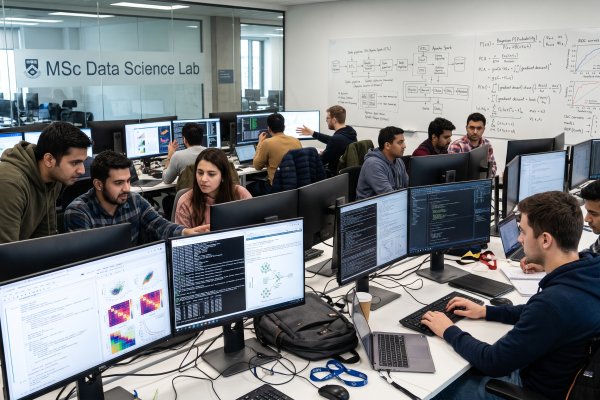
The programme combines academic learning with practical laboratory sessions, programming exercises, data analysis activities, research-based assignments and an independent postgraduate project.
Students develop the ability to manage datasets, apply statistical techniques, build predictive models, interpret analytical results and communicate findings to support evidence-based decision-making.
The programme also strengthens professional skills in critical thinking, quantitative analysis, problem-solving, technical communication, research and project management.
The MSc Data Science is particularly suitable for graduates in Computer Science, Computing, Information Technology, Mathematics, Statistics, Engineering, Physics and other relevant quantitative disciplines who wish to develop advanced capabilities in data analytics, machine learning and intelligent computing.
What Will You Study?
The MSc Data Science at the University of Greenwich is designed to develop advanced knowledge of statistical analysis, programming, machine learning, big data technologies and practical data science applications.
The programme combines compulsory modules with specialist options, allowing students to develop technical expertise in different areas of data science.
Core and Compulsory Modules
The published 2027/28 programme structure includes the following compulsory modules:
MSc Project: Undertake an independent research or applied data science project addressing a relevant problem. Develop research questions, review existing literature, select appropriate analytical methods, process and analyse data, evaluate findings and present your conclusions in a structured postgraduate project.
Big Data: Explore the technologies and techniques used to manage, process and analyse large and complex datasets. Understand data storage, distributed computing, scalable processing and the challenges of working with high-volume information.
Data Visualisation: Learn how to present complex datasets through meaningful visual representations. Explore visual analytics, graphical techniques, data interpretation and effective communication of analytical findings.
Machine Learning: Study the principles and practical applications of machine learning. Explore algorithms that identify patterns in data, make predictions and support automated decision-making.
Programming Fundamentals for Data Science: Develop programming knowledge and computational skills required to work with data science applications. Learn how programming supports data preparation, analysis, modelling and automation.
Ethics in Data Science: Examine the ethical, legal and social responsibilities involved in collecting, processing and analysing data. Explore privacy, data protection, algorithmic bias, fairness, transparency and responsible data use.
Essential Professional and Academic Skills for Masters Students: Develop the academic, communication, research and professional capabilities needed to succeed in postgraduate study and prepare for professional data-related careers.
Statistical Methods for Time Series Analysis: Explore statistical techniques for analysing data collected over time. Understand time-dependent patterns, trends, seasonality, forecasting and the application of statistical models to real-world datasets.
Optional Modules
Students can tailor aspects of their learning through specialist optional modules.
The published programme includes options such as:
Clouds, Grids and Virtualisation: Explore cloud computing environments, distributed computing resources, virtualisation and technologies used to support scalable data processing.
Blockchain for FinTech Applications: Understand blockchain technology and its applications in financial technology, digital transactions and secure information management.
Technologies for Anti-Money Laundering and Financial Crime: Examine how modern data and technology solutions support the detection, prevention and investigation of financial crime.
Graph and Modern Databases: Explore graph-based data structures, modern database technologies and methods for managing complex relationships between different types of information.
Optional module availability may depend on academic scheduling, student numbers and programme arrangements.
Additional Data Science Knowledge
Through the programme's modules and applied learning activities, students can also develop broader knowledge of contemporary data science techniques.
Important subject areas include:
Python for Data Science: Understand how Python is used for data cleaning, data manipulation, statistical analysis, automation and machine learning.
Statistical Analysis: Apply descriptive and inferential statistical methods to identify patterns, evaluate relationships and draw conclusions from datasets.
Predictive Analytics: Develop an understanding of techniques used to forecast future outcomes and support evidence-based decisions.
Data Mining: Explore methods for discovering patterns, relationships and useful information from large datasets.
Database Management: Understand how data is stored, organised, retrieved and managed within modern information systems.
Business Intelligence: Examine how data analytics and reporting tools support strategic planning, operational management and organisational decision-making.
Artificial Intelligence Applications: Explore the relationship between artificial intelligence, machine learning and data science.
Responsible Data Management: Understand the importance of data quality, security, privacy, governance and ethical analytical practices.
These additional subject areas complement the published programme structure and help students understand the wider applications of data science.
The exact module titles, credit values and optional module availability should be checked against the university's latest approved programme specification.
Who Is This Course For?
The MSc Data Science is designed for graduates who want to develop advanced analytical, programming and computational capabilities.
It may be particularly suitable for:
Graduates in Computer Science.
Graduates in Computing.
Graduates in Information Technology.
Graduates in Data Science.
Graduates in Mathematics.
Graduates in Statistics.
Graduates in Physics.
Graduates in Engineering.
Graduates in Artificial Intelligence.
Graduates in Information Systems.
Business and finance graduates with strong quantitative backgrounds.
IT professionals interested in data analytics.
Software developers seeking to specialise in data science.
Professionals interested in machine learning and predictive analytics.
Graduates planning careers in business intelligence and data research.
Applicants should have an appropriate academic background in a relevant STEM, computing, mathematical or numerate discipline.
Professionals with relevant industry experience in data science, programming, computing or data analytics may also be considered individually by the university.
Entry Requirements
The MSc Data Science at the University of Greenwich is designed for applicants who have successfully completed an appropriate undergraduate qualification.
The published standard academic entry requirement is:
An undergraduate honours degree at 2:2 or above.
A relevant degree in Computing, Computer Science, Artificial Intelligence, Data Science, Mathematics, Physics, Engineering, Statistics, Information Technology or another relevant STEM or numerate subject.
Applicants with relevant commercial or industry experience may also be considered individually, even if they do not hold a conventional undergraduate degree.
The university assesses whether applicants have the appropriate academic background, professional experience and ability to succeed in postgraduate study.
International Academic Qualifications
International applicants must demonstrate that their previous academic qualifications meet the university's postgraduate admission requirements.
Relevant qualifications may include:
Bachelor's degrees in Computer Science.
Bachelor's degrees in Information Technology.
Bachelor's degrees in Software Engineering.
Bachelor's degrees in Mathematics.
Bachelor's degrees in Statistics.
Bachelor's degrees in Physics.
Bachelor's degrees in Engineering.
Bachelor's degrees in Artificial Intelligence.
Other recognised quantitative or STEM qualifications.
Applicants should provide:
Previous academic certificates.
Complete academic transcripts.
Details of previously studied subjects and modules.
Updated CV, where relevant.
Evidence of professional experience, where applicable.
Evidence of English language proficiency.
Any additional documents requested by the university.
International qualifications are assessed according to the University of Greenwich's country-specific admissions requirements.
Applicants with degrees in unrelated subjects may wish to explore the university's MSc Data Science and its Applications, which is designed for students from a wider range of academic backgrounds.
English Language Requirements
International applicants must demonstrate sufficient English language proficiency to participate in postgraduate academic study.
English language requirements depend on the applicant's country of education and the university's approved qualifications.
Applicants should check the current IELTS Academic requirement and any individual component requirements with the University of Greenwich before submitting an application.
Approved equivalent English language qualifications may also be accepted.
Practical Learning and Data Science Experience
Practical learning is an important component of advanced data science education.
The University of Greenwich combines academic study with practical laboratory sessions, programming activities and independent research to help students apply analytical techniques to real-world problems.
Practical learning may include:
Working with real-world datasets.
Cleaning and preparing complex data.
Developing Python programming solutions.
Applying statistical analysis techniques.
Building and evaluating machine learning models.
Conducting predictive analytics.
Analysing large datasets.
Creating data visualisations and dashboards.
Working with database technologies.
Exploring cloud-based computing environments.
Analysing time series data.
Investigating ethical data management challenges.
Completing an independent data science project.
Students have access to specialist computer laboratories and high-performance computing facilities to support technical learning and data processing activities.
Teaching also includes lectures, tutorials, practical laboratory work, independent study and project-based learning.
These experiences help students connect statistical and computational theory with practical data science applications.
Skills You Will Develop
Throughout the programme, students can develop a range of advanced technical, analytical and professional skills, including:
Data science and analytical thinking
Python programming
Statistical analysis and modelling
Machine learning
Big data processing
Data visualisation
Predictive analytics
Data mining
Database management
Time series analysis
Data interpretation and reporting
Business intelligence
Research design and methodology
Data governance and ethics
Problem-solving and critical thinking
Quantitative analysis
Technical communication
Independent project management
These transferable skills can support career development across technology companies, financial institutions, healthcare organisations, government departments, research institutions and multinational businesses.
Career Opportunities
The MSc Data Science can provide an academic and technical foundation for exploring specialist employment opportunities across data analytics, machine learning, business intelligence and research.
Potential career pathways include:
Data Scientist
Data Analyst
Senior Data Analyst
Machine Learning Engineer
Data Engineer
Business Intelligence Analyst
Data Analytics Consultant
Statistical Analyst
Research Data Analyst
Predictive Analytics Specialist
Data Visualisation Specialist
Big Data Analyst
Business Analyst
AI Data Specialist
Database Analyst
Quantitative Analyst
Data Governance Analyst
Analytics Consultant
Research Scientist
Graduates may find opportunities with:
Technology and software companies.
Banks and financial institutions.
Healthcare organisations.
Government departments.
Telecommunications companies.
Retail and e-commerce businesses.
Consulting organisations.
Manufacturing companies.
Research institutions and universities.
International business organisations.
With relevant professional experience and continued development, graduates may progress into senior data science, machine learning, analytics consultancy, data engineering and data management leadership positions.
Career progression depends on individual experience, technical capabilities, employer requirements and continued professional development.
Professional Recognition and Accreditation
Professional recognition is an important consideration when selecting a postgraduate data science programme.
The data science profession includes several recognised organisations that support the development of computing, analytical and data management professionals.
Students may explore professional membership and development opportunities through organisations such as:
British Computer Society (BCS).
Royal Statistical Society (RSS).
Institute of Analytics.
Association for Computing Machinery (ACM).
Institute of Electrical and Electronics Engineers (IEEE).
These organisations offer professional development, networking opportunities, specialist resources and relevant membership pathways.
Professional membership and certifications are separate from the university degree and may involve additional eligibility requirements and fees.
Applicants should confirm whether any programme-specific accreditation or professional exemptions apply directly with the university.
Progression to Further Study
After successfully completing the MSc Data Science, graduates may consider further academic research or specialist postgraduate development.
Potential progression routes include:
PhD in Data Science.
PhD in Computer Science.
PhD in Artificial Intelligence.
PhD in Machine Learning.
PhD in Statistics.
PhD in Computational Mathematics.
PhD in Big Data Analytics.
PhD in Health Data Science.
PhD in Business Analytics.
Doctoral research in Data Mining.
Doctoral research in Statistical Modelling.
The master's degree can provide an academic foundation for doctoral applications, subject to the research institution's admission requirements and the applicant's research background.
Graduates interested in academic and research careers may also explore research assistant, research associate and doctoral researcher opportunities.
Course Duration and Study Mode
The MSc Data Science at the University of Greenwich offers the following study arrangements:
Full-time: One year.
Part-time: Two years.
Standard September intake.
Additional January intake.
Campus: Greenwich Campus, London.
Teaching and learning combine lectures, tutorials, practical laboratory sessions and independent study.
Students participate in specialist computer laboratory activities, programming exercises, research-based assignments and project work.
Assessment methods include coursework, examinations, practical activities, presentations, reports and a substantial independent MSc project.
The academic year includes dedicated time for completing the final project.
Tuition Fees and Intakes
Tuition fees depend on the academic year, applicant category and study mode.
For the University of Greenwich's published 2027/28 course information:
International tuition fee: To be confirmed.
UK tuition fee: To be confirmed.
Full-time duration: One year.
Part-time duration: Two years.
Start dates: September and January 2027/28.
The university has not yet published the confirmed 2027/28 tuition fee on the official course page.
International applicants should confirm the latest tuition fees, application deadlines, payment arrangements, deposit requirements, scholarships, available places and overseas admission requirements directly with the University of Greenwich.
Why Study Data Science in the UK?
The UK is an established destination for postgraduate education, technology research and data-driven innovation.
UK universities offer programmes that combine statistical theory, programming, machine learning and practical analytical applications to prepare graduates for a wide range of data-related careers.
Studying an MSc Data Science in the UK provides an opportunity to develop advanced skills in data analysis, big data processing, predictive modelling, data visualisation and intelligent computing.
The UK also has a diverse economy involving finance, healthcare, technology, manufacturing, government and professional services, all of which increasingly rely on data-driven decision-making.
A postgraduate qualification can help graduates strengthen their analytical expertise, develop professional capabilities and explore opportunities across the expanding data science sector.
Whether your ambition is to become a data scientist, machine learning engineer, business intelligence analyst, data engineer or research professional, this master's degree can provide a valuable next step in your academic and professional journey.
Get Guidance on Studying MSc Data Science in the UK
Choosing the right MSc Data Science programme involves comparing university options, academic entry requirements, programming knowledge, mathematical preparation, specialist modules, practical laboratory facilities, tuition fees and postgraduate career opportunities.
Our education consultancy can help prospective students assess their academic qualifications, explore suitable UK university options and prepare their postgraduate applications.
Contact our team for guidance on the MSc Data Science and opportunities to advance your career through postgraduate study in the UK.


