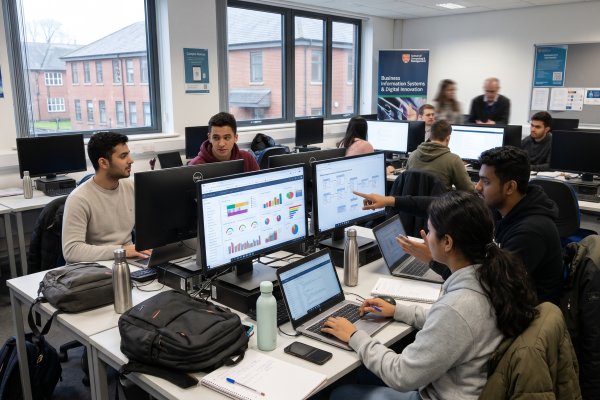
BSc (Hons) Business Information Systems UK | Degree
Course Overview
The BSc (Hons) Business Information Systems is an undergraduate degree programme designed to develop the technical, analytical and business management skills required to connect information technology with modern organisational needs.
In today's digital economy, businesses depend on information systems to manage operations, analyse data, communicate with customers and make informed decisions. From financial institutions and retail companies to healthcare organisations and multinational corporations, technology plays an essential role in improving business performance and supporting organisational growth.
This programme combines business knowledge with computing and information technology, helping students understand how digital systems are designed, developed, implemented and managed within organisations.
Students explore how businesses collect, process, store and use information to improve decision-making, manage resources and solve operational challenges. The programme also introduces the relationship between people, technology, data and organisational processes.
Throughout the degree, students study important areas such as business information systems, programming, database management, systems analysis and design, business analytics, digital business, project management and information security.
Through practical assignments, technical workshops, business case studies, database projects and collaborative activities, students develop the ability to analyse business requirements and recommend effective technology-based solutions.
The programme also develops essential professional skills in communication, critical thinking, problem-solving, teamwork, project coordination and ethical decision-making.
The BSc (Hons) Business Information Systems is particularly suitable for individuals interested in business technology, business analysis, information management, digital transformation, enterprise systems and technology consultancy.
What Will You Study?
The BSc (Hons) Business Information Systems is generally delivered over three years of full-time undergraduate study, divided into three academic levels.
Year 1 – Level 4
The first year introduces students to the fundamental principles of business information systems, computing, programming and data management.
Key areas of study include:
Fundamentals of Information Systems: Understand how organisations use information systems to manage business activities, support operations and improve decision-making.
Business Computing: Explore the application of computer technologies in business environments, including digital tools, information processing and organisational systems.
Programming Fundamentals: Develop basic programming knowledge, logical reasoning and computational problem-solving skills.
Data Analytics and Statistics: Learn how to collect, organise, analyse and interpret business data to identify patterns and support management decisions.
Database Design and Management: Understand database structures, data organisation, information storage and the principles of designing effective database systems.
Web Design and Development: Explore website development, web technologies, digital communication and the role of online platforms in business.
Requirements Modelling: Learn how to identify business needs, understand user requirements and represent the processes needed to develop an effective information system.
Year 2 – Level 5
The second year develops specialist knowledge of information systems, business technology and digital management.
Key areas of study include:
Information Systems Analysis and Design: Learn how to investigate business requirements, analyse existing systems and design appropriate technology-based solutions.
Business Information Systems Development: Explore the development and implementation of information systems that support organisational processes and business objectives.
Business Analytics: Develop skills in analysing business information, interpreting data and using analytical techniques to support organisational decisions.
Database Systems: Study database management, advanced data organisation, data retrieval and the application of database technologies.
Information Technology Security: Understand information security, data protection, access control and the importance of protecting organisational information.
Digital Business: Explore how digital technologies influence business models, customer relationships, organisational operations and competitive strategies.
Agile Project Management: Understand project planning, teamwork, resource management and flexible approaches to delivering technology projects.
Collaborative Business Technology Project: Work with other students to analyse a business problem and develop a practical information systems solution.
Year 3 – Level 6
The final year develops advanced analytical, strategic and professional skills for managing information systems and supporting digital business transformation.
Key areas of study include:
Strategic Management of Information Systems: Examine how organisations use information technology to achieve strategic objectives, improve performance and develop competitive advantages.
Business Analytics and Intelligence: Explore advanced approaches to business data analysis, reporting, visualisation and evidence-based decision-making.
Technology Project Management: Develop knowledge of managing technology projects, coordinating resources, monitoring progress and evaluating project outcomes.
Enterprise Systems and Digital Transformation: Understand how integrated information systems support organisational activities and help businesses adapt to technological change.
Information Management and Digital Innovation: Explore how organisations manage information resources, introduce new technologies and develop innovative business solutions.
Professional, Sustainable and Ethical Technology: Examine professional responsibilities, ethical considerations, sustainability and the wider impact of technology on organisations and society.
Independent Development Project: Complete a substantial individual project involving the analysis, design, development and evaluation of a technology-based solution to a business or organisational problem.
Some universities also offer specialist options such as cybersecurity, cryptography, financial technology (FinTech), mobile technologies and business intelligence.
The exact module titles, optional subjects and assessment methods depend on the university's approved programme specification and academic year.
Who Is This Course For?
The BSc (Hons) Business Information Systems is suitable for individuals who are interested in both business management and information technology.
It may be particularly suitable for:
School and college leavers interested in business and computing.
Students interested in how technology supports business operations.
Individuals interested in business analysis and systems development.
Learners interested in database management and business analytics.
Students interested in digital transformation and enterprise technology.
Individuals interested in IT consultancy and technology management.
Students who enjoy problem-solving, data analysis and business decision-making.
Business or IT professionals seeking further academic qualifications.
Mature learners interested in developing a career at the intersection of business and technology.
Previous professional IT experience is not generally required for undergraduate entry. An interest in business, computing, analytical thinking and digital technologies can be beneficial.
Entry Requirements
Entry requirements vary depending on the university and the applicant's academic background.
For De Montfort University's standard BSc (Hons) Business Information Systems programme, the published typical entry requirements include:
A-level qualifications: BBC.
UCAS Tariff: 112 points.
BTEC Extended Diploma: DMM.
T Levels: Merit.
International Baccalaureate: 26 points.
GCSEs: Five subjects at grade 4/C or above, including English and Mathematics.
Other recognised Level 3 qualifications and equivalent international academic qualifications may also be considered.
Applicants should check the specific academic requirements and accepted overseas qualifications with their chosen university.
English Language Requirements
International applicants must demonstrate sufficient English language proficiency to participate in undergraduate academic study.
For De Montfort University's programme, the published English language requirement is:
IELTS Academic 6.0 overall.
No individual component below 5.5.
Equivalent English language qualifications may also be accepted under the university's admissions policy.
Applicants should confirm the latest English language requirements before submitting an application.
Practical Learning and Industry Experience
Practical learning is an important part of Business Information Systems education. Students develop an understanding of how information technology can be used to solve business problems and improve organisational performance.
Depending on the university's facilities and curriculum, practical learning may include:
Analysing business requirements and organisational processes.
Designing and developing database systems.
Creating business reports and data visualisations.
Developing basic software and programming applications.
Evaluating existing business information systems.
Preparing information systems design proposals.
Working with business analytics software.
Developing digital business solutions.
Managing collaborative technology projects.
Evaluating information security and data protection requirements.
Participating in real-world business case studies.
Completing industry-related assignments and practical projects.
Students may gain experience with technologies and software such as Python, SQL, Microsoft Excel, Power BI, database management systems, data analytics applications and business information platforms, depending on the university's curriculum.
Some universities also offer opportunities for industrial placements, employer-led projects, professional workshops and business consultancy activities.
These experiences help students understand how technology professionals work with business managers, employees and other stakeholders to deliver effective digital solutions.
Skills You Will Develop
Throughout the programme, students can develop a range of technical, analytical and professional skills, including:
Business information systems management
Business analysis and requirements modelling
Database design and management
Programming and computational thinking
Business analytics and data interpretation
Information systems analysis and design
Digital business management
Technology project management
Enterprise systems and digital transformation
Information security and data protection
Business process improvement
Strategic information management
Critical thinking and problem-solving
Professional communication and teamwork
These transferable skills can support career development across financial institutions, technology companies, consulting firms, retail organisations, healthcare providers and public sector organisations.
Career Opportunities
The BSc (Hons) Business Information Systems can provide an academic foundation for exploring employment opportunities across business, information technology and digital transformation.
Potential career pathways include:
Business Systems Analyst
Business Analyst
Information Systems Analyst
IT Business Analyst
Information Technology Consultant
Business Intelligence Analyst
Data Analyst
Database Administrator
Systems Development Assistant
IT Project Coordinator
Digital Transformation Analyst
Enterprise Systems Analyst
Technology Project Assistant
Information Management Specialist
Business Process Analyst
IT Operations Analyst
With relevant professional experience, industry certifications and further development, graduates may progress into senior business analysis, information systems management, technology consultancy and digital transformation leadership positions.
Some specialist roles may require additional technical qualifications or practical experience.
Professional Recognition and Industry Accreditation
Professional accreditation can be an important consideration when choosing a Business Information Systems degree.
The British Computer Society (BCS), The Chartered Institute for IT, is a recognised professional organisation supporting standards and professional development in computing and information technology.
De Montfort University's Business Information Systems degree has achieved initial BCS accreditation, subject to final review of degree outputs after the first cohort graduates, as described in its published course information.
BCS accreditation can support progression towards relevant professional recognition, subject to the applicable academic and professional requirements.
Students should check the current accreditation status and professional recognition arrangements for their specific year of entry.
Progression to Further Study
After successfully completing the BSc (Hons) Business Information Systems, graduates may consider postgraduate education in business, computing, information management and related disciplines.
Potential progression routes include:
MSc Business Analytics
MSc Information Systems Management
MSc Management Information Systems
MSc Business Information Technology
MSc Digital Transformation
MSc Data Science
MSc Information Technology
MSc Business Intelligence
MSc Project Management
MSc Cyber Security
MSc Software Engineering
MBA (Master of Business Administration)
Postgraduate admission depends on the university's entry requirements, academic performance and relevant experience.
Course Duration and Study Mode
The BSc (Hons) Business Information Systems at De Montfort University is offered over three years on a full-time basis.
The programme structure consists of:
Year 1: Level 4 – Business computing, information systems, programming, data analytics and databases.
Year 2: Level 5 – Systems analysis, business technology, database systems and project management.
Year 3: Level 6 – Strategic information systems, business intelligence, technology management and independent project work.
An optional industrial placement year may extend the programme to four years.
Teaching may include lectures, seminars, technical workshops, computer laboratory sessions, group projects, business case studies, presentations and independent study.
Tuition Fees and Intakes
Tuition fees depend on the university, academic year, applicant category, campus and study mode.
UK and international students may be charged different annual tuition fees. Optional placement years may also have a separate fee arrangement.
Universities commonly offer September entry, although selected institutions may provide additional start dates.
International applicants should confirm the latest tuition fees, available intakes, application deadlines, payment arrangements, placement eligibility and overseas admission requirements directly with their chosen university.
Why Study Business Information Systems in the UK?
Businesses across the world are increasingly dependent on information technology, digital platforms and data-driven management.
The UK offers a range of undergraduate programmes that combine business education with computing, information systems and practical technology applications.
Studying Business Information Systems in the UK can help learners develop the ability to understand organisational needs, analyse business information and contribute to the development of effective digital solutions.
The programme is particularly valuable for students who want to combine business knowledge with technical skills rather than focus exclusively on software programming or traditional business management.
Whether your ambition is to become a business analyst, information systems specialist, technology consultant or digital transformation professional, this degree can provide a valuable academic foundation.
Get Guidance on Studying Business Information Systems in the UK
Choosing the right Business Information Systems degree involves comparing university options, course modules, professional accreditation, practical learning opportunities, industrial placements, entry requirements, tuition fees and future career pathways.
Our education consultancy can help prospective students explore suitable UK university options, understand admission requirements and prepare for the application process.
Contact our team for guidance on the BSc (Hons) Business Information Systems and available opportunities to study in the UK.


